The Exotic Revival Victorian: How to Identify the Well-Travelled Guest
Egyptian, Moorish or Swiss Chalet: how to recognise an Exotic Revival house by her imported motif, and why fancy brackets alone never qualify.

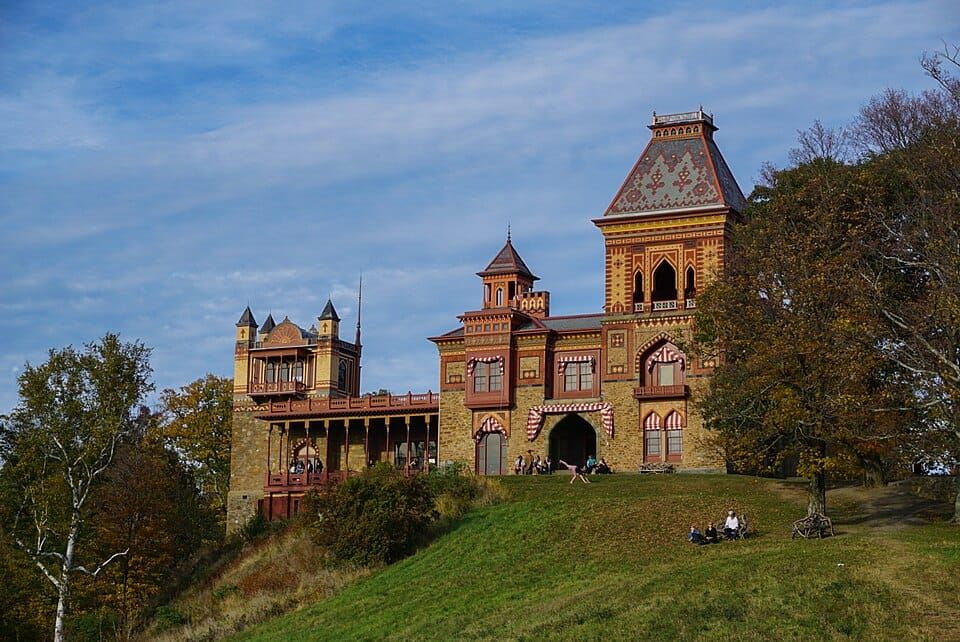
An Exotic Revival house is the Victorian lady who has travelled: she wears a named foreign motif, Egyptian, Moorish or Swiss Chalet, and without it she has no claim to the title.
Dearest reader, she is rare and adventurous, and I name her only when I can name her motif. Fancy brackets alone make a lady well dressed, not exotic.
In this guide:
- How to Spot Her: The Exotic Revival Must-See and Features
- Exotic Revival Dates and Where She Lives
- Do Not Confuse Her With...
- Frequently Asked Questions
How to Spot Her: The Exotic Revival Must-See and Features
First, her year
Her year comes first, and for this lady it matters doubly. My Victorians were built between 1837 and about 1915; a listing before 1830 or after 1925 is turned away, and one between 1916 and 1925 must prove her age in her roof, walls and trim and never gets a style name outright. Before 1920 a listed year is often an assessor's guess, so it is a hint, never proof.
Egyptian and Moorish houses came back into fashion in the 1920s and 1930s, so an exotic lady's date must not place her in that later revival. If it does, I do not name her Exotic Revival, however splendid her arches.
The must-see: one named imported motif
Her must-see is one named imported motif, clearly visible on her own outside. The Pennsylvania Historical and Museum Commission describes three:
- Egyptian: a rolled cavetto cornice, window surrounds that narrow toward the top, columns like bundled reeds, the vulture and winged sun disk.
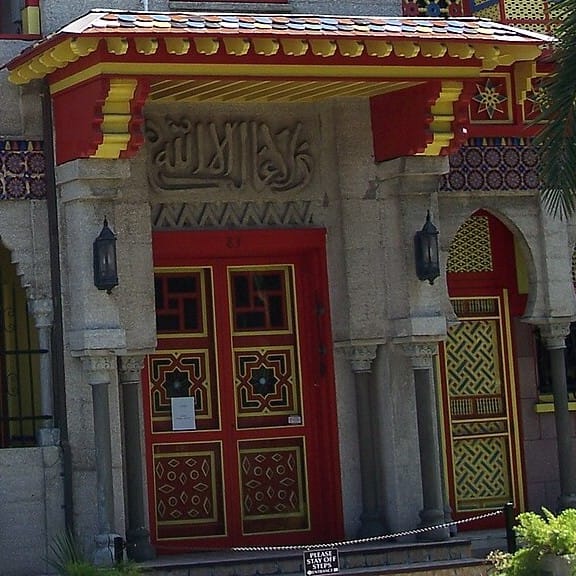
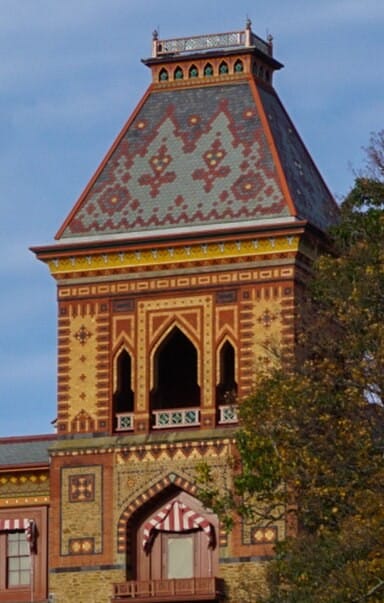
- Moorish: ogee arches, an onion dome or minaret, recessed porches, mosaic tile trim, and complex, intricate details with a Middle Eastern or Moorish theme, such as the horseshoe arches, Arabic lettering, carved latticework and decorated parapets that the National Register record for Villa Zorayda describes. Mosaic means a pattern built from many small pieces; a band of larger tiles, each painted with its own design, is not mosaic, though it is still Moorish detail.
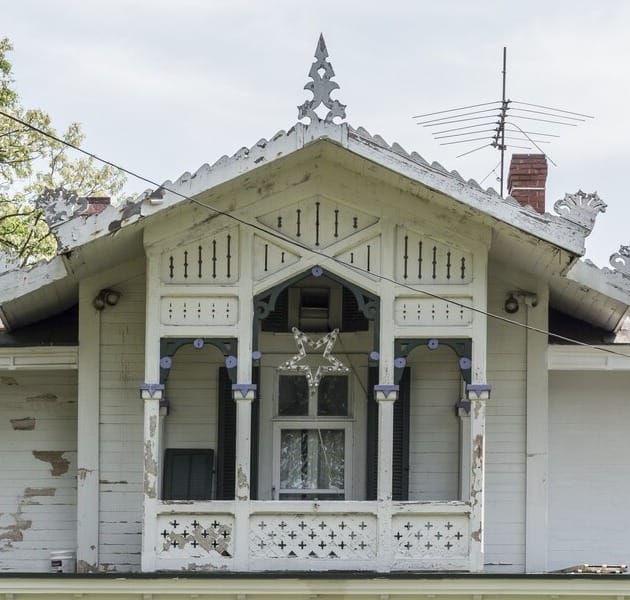
- Swiss Chalet: a low, wide-eaved front gable with cut-out trim, a second-floor porch or balcony with a cut-out balustrade, and patterned stickwork.
Generic brackets or spindles are never enough.
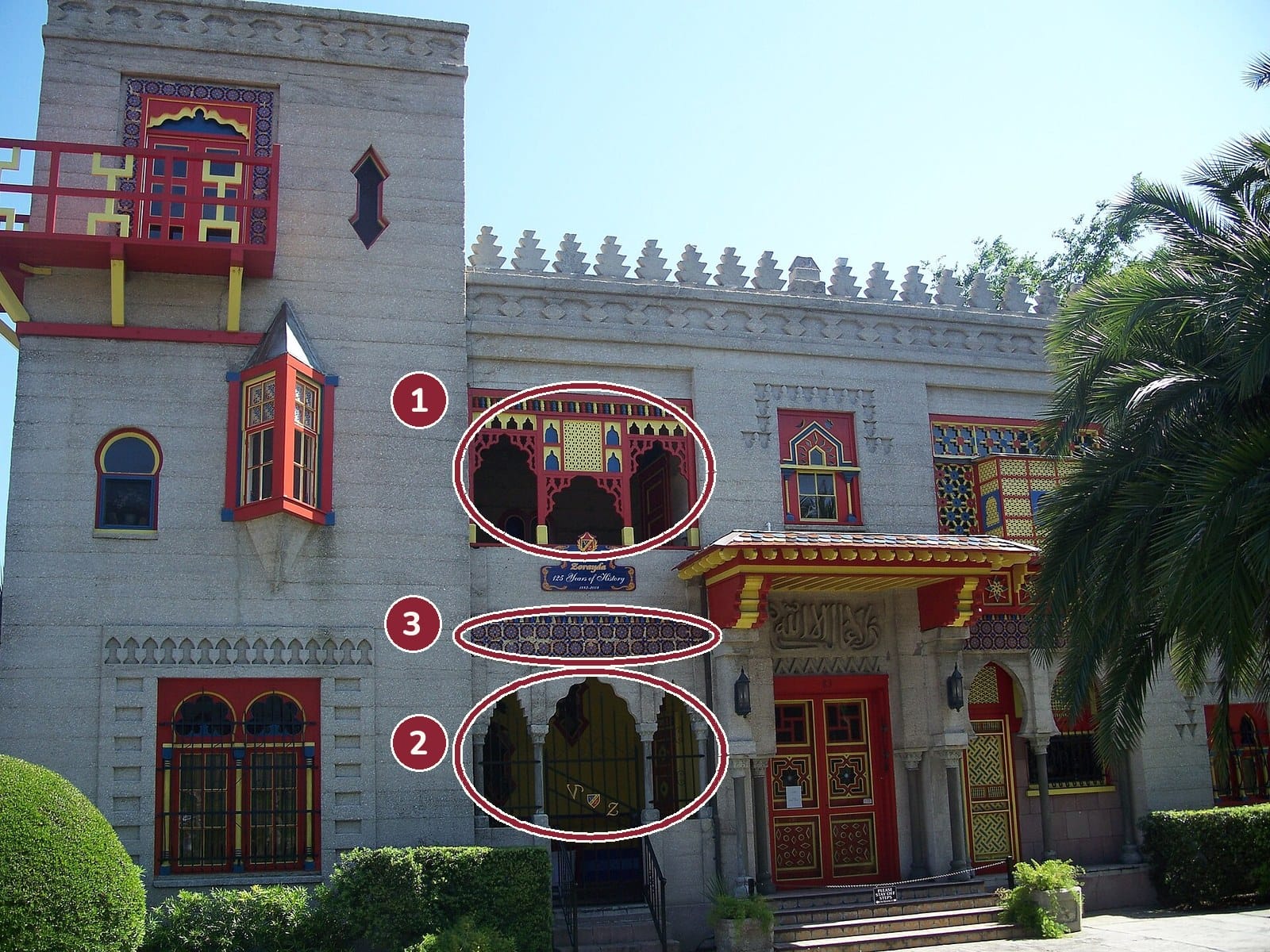
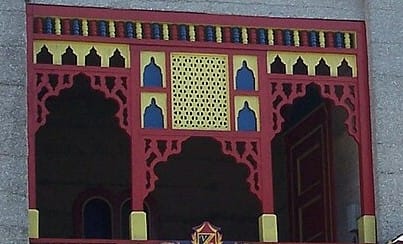
- 1Lobed, pointed Moorish arches on the upper loggia: a detail with a Middle Eastern or Moorish theme, and her must-see motif.
- 2A recessed, arcaded porch: on the Moorish list.
- 3A band of patterned tiles above the lower arcade. Each tile carries its own star or rosette, so it is not mosaic, but it is Moorish detail all the same.
The features that count
The features that count are the other items on her own sub-style's list above. A Moorish lady proves herself with more Moorish detail, a chalet with more chalet detail. Mixing lists does not count.
Three features, at the very least
Three things, darling. She needs her motif plus at least two more features from the same sub-style's list, and her date must not conflict.
She must also keep most of her character. The National Register judges a house by six qualities: her massing, where her porches and bays sit, her proportions, the pattern of her windows and doors, the texture of her walls and roof, and her ornament. I want at least four of the six still reading as her style, and her ornament must be one of the four (National Register Bulletin 15, p. 46).
Her fatal losses
The motif gone, for example a chalet's cut-out balcony removed. Without it she is simply a house with good taste in travel.
Only her own outside
Only her own outside counts: never the neighbour's dome, never a street view or an aerial in which she is small or unclear, never her interiors, never the listing's words about her style. A motif half hidden by palms is not counted until another photograph shows it clearly.
Shall I send the season's finest Victorians straight to you? New listings and my honest verdicts. Turrets, towers and trim, never a tract home in disguise.
Subscribe freeExotic Revival Dates and Where She Lives
Her dates are contested. The Pennsylvania commission gives two periods, about 1830 to 1850 and 1920 to 1930, and calls all three sub-styles rare in Pennsylvania. McAlester, as cited by a library blog, gives 1835 to 1890 and treats the three as one movement of ornament applied to houses of the Romantic era.
Egyptian work was mostly public: banks, prisons, courthouses and cemeteries, applied to bodies that are otherwise Greek Revival or Italianate. The Swiss Chalet was promoted in Andrew Jackson Downing's pattern books for rustic and mountain settings. She is rare wherever you look, which is precisely her charm.
Do Not Confuse Her With...
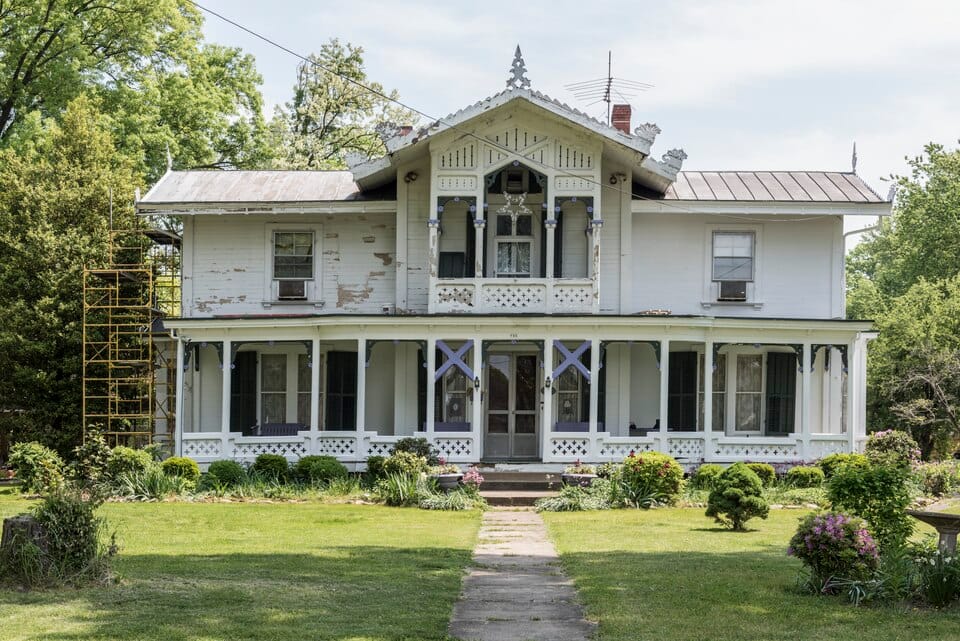
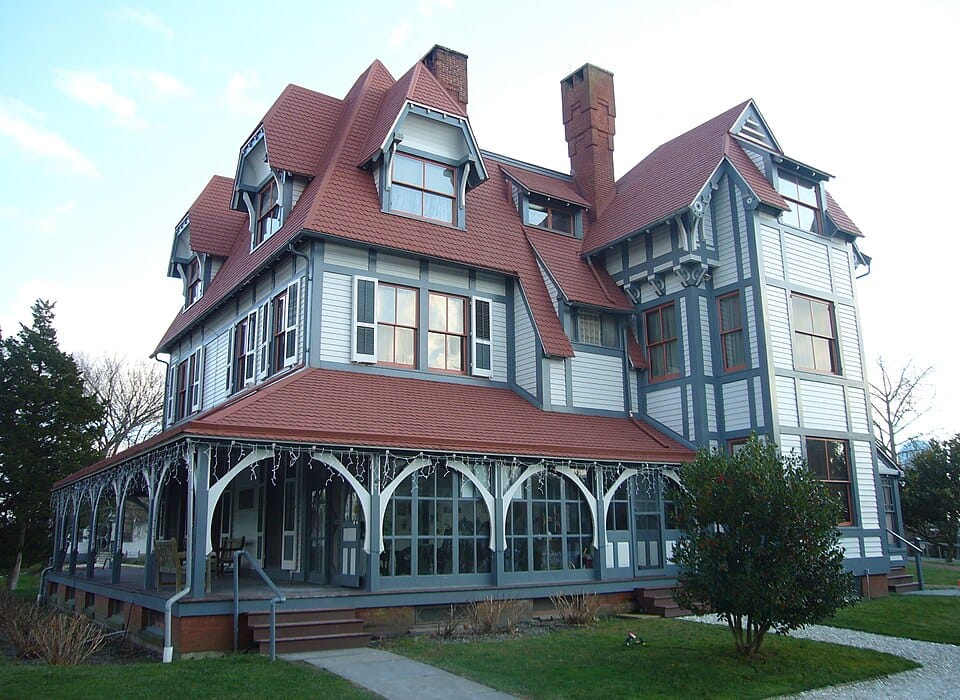
Stick and Carpenter Gothic. Stickwork and cut-out trim appear on all three. The low, wide-eaved gable with a cut-out balcony is the chalet's own combination; a grid of flat boards over clapboard walls means Stick; pointed openings mean Gothic.
Greek Revival or Italianate, for the Egyptian lady. Egyptian ornament is applied to those bodies, so look for the cavetto cornice, the narrowing window surrounds, the bundled-reed columns or the winged disk.
Any house with fancy brackets. Brackets are worn by nearly everyone at this ball, and prove nothing about where a lady has been.
Dearest reader, the best houses are spoken for quickly. Subscribe and I shall write to you the moment a worthy Victorian comes to market.
Join the ChronicleFrequently Asked Questions
What is an Exotic Revival house?
A Victorian-era house dressed in a named imported motif: Egyptian, Moorish or Swiss Chalet. She needs the motif plus two more features from the same sub-style's list.
What are the Exotic Revival styles?
Egyptian (cavetto cornices, window surrounds narrowing upward, bundled-reed columns, the winged sun disk), Moorish (ogee arches, onion domes or minarets, recessed porches, mosaic tile trim, and other intricate details with a Middle Eastern or Moorish theme, such as horseshoe arches or patterned tile) and Swiss Chalet (a low wide-eaved front gable with cut-out trim, a cut-out balcony and patterned stickwork).
How do you tell a Swiss Chalet from a Stick house?
Both use stickwork and cut-out trim. A low, wide-eaved front gable with a cut-out balcony is the chalet; a grid of flat boards dividing clapboard walls into panels is Stick.
When were Exotic Revival houses built?
Sources disagree: about 1830 to 1850 and again 1920 to 1930 according to the Pennsylvania state preservation office, or 1835 to 1890 according to McAlester as cited by a library blog.
Is a Moorish-style house from the 1920s Victorian?
No. Egyptian and Moorish styles were revived in the 1920s and 1930s, after the Victorian era, so a house from those years is not Victorian, however exotic.
See every style side by side in Lady Margaret's Field Guide.
Photo credits
- Olana (Frederic Edwin Church house): Ɱ, CC BY-SA 4.0, via Wikimedia Commons
- Villa Zorayda (Zorayda Castle) (numbered circles added by The Cresting Chronicle; shared under the same licence): Ebyabe, CC BY-SA 3.0, via Wikimedia Commons
- Villa Zorayda (Zorayda Castle) (cropped; shared under the same licence): Ebyabe, CC BY-SA 3.0, via Wikimedia Commons
- Olana (Frederic Edwin Church house) (cropped; shared under the same licence): Ɱ, CC BY-SA 4.0, via Wikimedia Commons
- Parsons-Abbott-Mosser House (cropped; shared under the same licence): Carol M. Highsmith, public domain, Library of Congress (Carol M. Highsmith Archive), via Wikimedia Commons
- Parsons-Abbott-Mosser House: Carol M. Highsmith, public domain, Library of Congress (Carol M. Highsmith Archive), via Wikimedia Commons
- Emlen Physick Estate: Staib, CC BY-SA 3.0, via Wikimedia Commons